

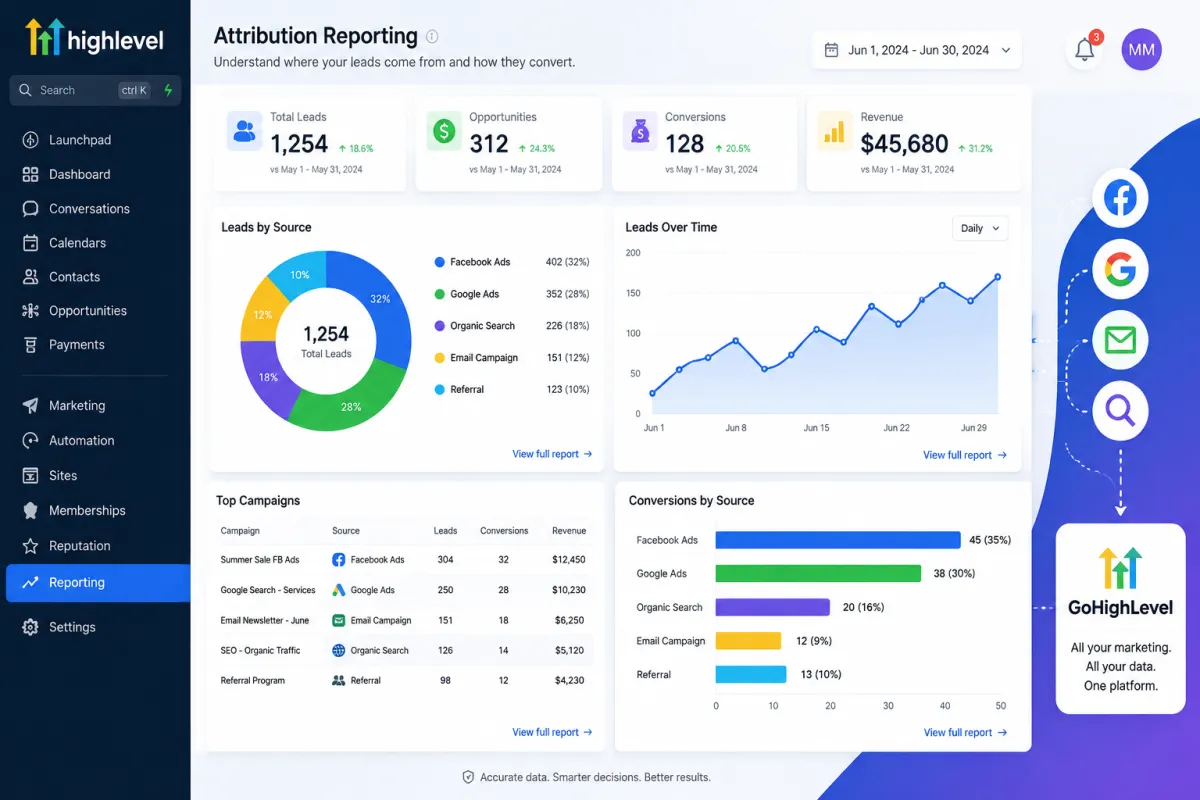
The Ultimate Guide to GoHighLevel Attribution Reporting
What Is Attribution Reporting in GoHighLevel?
In today's digital marketing landscape, businesses often invest in multiple channels like Facebook Ads, Google Ads, email marketing, and organic search. While these campaigns generate leads, one important question remains: Which marketing efforts are actually producing results?
Without proper attribution, marketers can only guess where valuable leads come from, making it difficult to optimize budgets or prove campaign success. This is where Attribution Reporting in GoHighLevel becomes valuable.
GoHighLevel provides reporting capabilities that help businesses and agencies understand where contacts originate and how marketing efforts contribute to business outcomes. Instead of relying on assumptions, users can analyze lead sources, review campaign performance, and make better marketing decisions based on real data.
If you want to improve marketing performance and better understand your customer journey, this guide explains everything you need to know.
How Attribution Reporting Works in GoHighLevel
Attribution Reporting is the process of identifying which marketing channels or campaigns influence a customer's journey before they become a lead or customer.
Within GoHighLevel, attribution reporting focuses on helping users understand where contacts originate and how those marketing sources contribute to opportunities and conversions recorded inside the CRM.
Rather than simply counting leads, attribution provides valuable context by answering questions such as:
Which campaigns generate the most leads?
Which channels produce higher-quality opportunities?
Where should marketing budgets be increased?
Which marketing efforts deserve improvement?
For agencies, this information is especially useful because it provides measurable insights that can support client reporting and demonstrate marketing performance.

Why Attribution Reporting Matters
Marketing decisions become much easier when they're backed by reliable data instead of assumptions.
Some key benefits include:
Better Marketing Decisions
Knowing which campaigns consistently generate qualified leads allows businesses to focus resources on strategies that produce meaningful results.
Understanding Lead Sources
Lead Source Tracking helps identify whether contacts come from paid advertising, organic search, referrals, email campaigns, or other marketing efforts.
Identifying High-Performing Campaigns
Instead of treating every campaign equally, marketers can recognize which ones generate the highest engagement and conversions.
Measuring Marketing ROI
Businesses spend significant budgets on advertising. Attribution Reporting helps connect marketing activities with measurable business outcomes, making ROI Tracking more transparent.
Optimizing Advertising Budgets
If one campaign consistently outperforms another, marketing teams can confidently adjust spending toward better-performing channels.
Improving Client Reporting
Agencies benefit from clearer Marketing Reports that show clients where leads originate and how campaigns contribute to business growth.

Key Features of Attribution Reporting in GoHighLevel
GoHighLevel's reporting tools provide visibility into marketing performance without requiring users to manually organize every data point.
Some important capabilities include:
Lead Source Tracking
When source information is available, GoHighLevel helps identify how contacts entered the CRM, giving marketers greater visibility into customer acquisition.
Campaign Performance Visibility
Businesses can review how different marketing campaigns contribute to lead generation and sales activities.
Conversion Attribution
As contacts move through the CRM, businesses can relate marketing efforts to opportunities and conversions, helping evaluate campaign effectiveness.
CRM Reporting
GoHighLevel Reporting combines marketing and CRM activity, making it easier to analyze business performance from one platform.
Contact Journey Insights
Understanding where contacts originate and how they progress through the sales pipeline helps businesses identify opportunities to improve customer experiences.
Data-Driven Decision Making
Instead of relying on assumptions, marketers can use reporting data to support future campaign planning and budget allocation.
How Attribution Reporting Works
The process is straightforward and easy to understand.
Step 1: A Visitor Arrives
A potential customer visits your website or landing page through a marketing source such as:
Facebook Ads
Google Ads
Email Campaigns
Organic Search
Step 2: The Visitor Becomes a Lead
The visitor submits a form, books an appointment, or performs another tracked action that creates a contact in GoHighLevel.
Step 3: Source Information Is Recorded
GoHighLevel stores available attribution information associated with the contact, helping identify where the lead originated.
Step 4: The Contact Moves Through the CRM
As your sales team works the lead, the contact progresses through pipeline stages and opportunities.
Step 5: Conversions Are Recorded
When the lead becomes a customer or reaches another important milestone, the CRM reflects that progress.
Step 6: Reports Provide Insights
Businesses can review reporting data to better understand which marketing efforts contribute to successful outcomes and make informed decisions for future campaigns.

Real-World Example
Imagine a digital marketing agency managing campaigns for a home services company.
The agency runs:
Facebook Ads
Google Ads
Email Marketing
Organic SEO
After several weeks, hundreds of leads have entered GoHighLevel.
Instead of guessing which campaign performed best, Attribution Reporting helps the agency compare lead sources and evaluate marketing performance. If Google Ads consistently generates more qualified opportunities while Facebook Ads produces a higher number of lower-quality leads, the agency can recommend shifting part of the advertising budget toward Google Ads.
This data-driven approach allows both the agency and the client to make smarter marketing decisions with greater confidence.

Best Practices
To get the most value from Attribution Reporting:
Use consistent campaign tracking across all marketing channels.
Clearly organize campaigns with descriptive naming conventions.
Review Marketing Reports regularly rather than only at month-end.
Focus on business outcomes instead of vanity metrics.
Compare multiple channels before increasing advertising budgets.
Use reporting insights to continuously improve future campaigns.
Common Mistakes to Avoid
Avoid these common issues when analyzing Attribution Reporting:
Ignoring attribution data when making marketing decisions.
Drawing conclusions before collecting enough campaign data.
Using inconsistent campaign naming conventions.
Failing to track lead sources consistently.
Focusing only on lead volume while ignoring lead quality.
Making budget changes based on short-term fluctuations rather than meaningful trends.
Conclusion
Understanding What Is Attribution Reporting in GoHighLevel is essential for businesses that want to make smarter marketing decisions. Instead of relying on assumptions, Attribution Reporting provides valuable visibility into where leads originate and how marketing efforts contribute to business outcomes.
Whether you're a business owner, marketer, or agency managing multiple campaigns, these insights can help improve Marketing ROI, optimize advertising budgets, and support more informed decision-making.
If you're already using GoHighLevel, take time to review your reporting data regularly. By using Attribution Reporting to guide future marketing strategies, you'll be better equipped to invest in the channels that deliver the greatest value for your business.
Frequently Asked Questions (FAQs)
1. What is Attribution Reporting in GoHighLevel?
Attribution Reporting in GoHighLevel helps businesses understand which marketing channels and lead sources contribute to contacts, opportunities, and conversions, allowing for better marketing analysis and decision-making.
2. Why is Attribution Reporting important?
It helps marketers identify successful campaigns, measure marketing ROI, optimize advertising budgets, and improve overall campaign performance using real business data.
3. Can agencies use GoHighLevel Attribution Reporting for client reporting?
Yes. Agencies can use GoHighLevel's reporting capabilities to provide clients with greater visibility into marketing performance, lead sources, and campaign effectiveness.
4. Does Attribution Reporting track multiple marketing channels?
When source information is available, GoHighLevel can help businesses analyze leads generated through various marketing channels such as paid advertising, email campaigns, and organic search, enabling more informed performance comparisons.
5. How often should I review Attribution Reports?
Reviewing reports weekly or monthly is generally recommended. Regular analysis helps identify trends, optimize campaigns, and make better budget decisions based on current marketing performance.
Need Expert Help with GoHighLevel?
New to GoHighLevel and ready to get started? Buy your GoHighLevel account here and launch with confidence.
Already know what you need and want our team to handle everything, from complete setup and customization to funnels, workflows, automations, CRM, and pipelines? Click here.